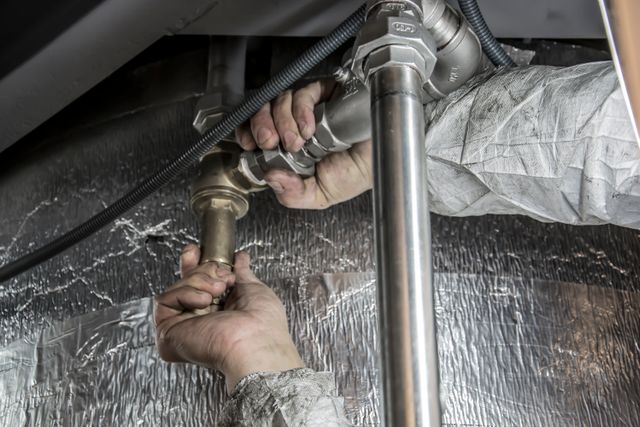
What sweating pipes under the sink look like
Meteorological Service Singapore describes the local climate as having "high and uniform temperatures, and high humidity all year round". That damp air sits inside a closed kitchen cabinet too. When cold water runs through the pipes under the sink, their outer surface cools, and moisture from the air settles on it as tiny beads. This is condensation on water pipe surfaces, like the outside of a glass of iced water.
Sweating shows as fine beads spread along the length of a cold pipe, often soon after cold water has run. The beads join, run to the lowest point and drip, so the wet patch on the cabinet base can sit some distance from where the water formed. A leak starts at one point, such as a joint, the bottle trap or the end of a hose, and the water keeps coming from that same spot.
Dry it and watch: a simple test
- Clear the cabinet. Leave any switch, socket or plug near the water alone, then empty the cabinet so you can see every pipe.
- Wipe it all dry. Use a dry cloth on each pipe, joint and hose, and on the trap under the sink.
- Lay paper towel. Spread dry paper towel along the cabinet base, directly under the pipes.
- Run the cold tap and watch. Run the cold tap for a few minutes, then look for where the first drops form and where the towel turns damp.
If beads form along the whole pipe and the paper towel shows small drips spread out beneath it, the pipes are sweating. A cold water pipe dripping from one joint only, or a single wet patch that keeps growing under the same fitting, points to a leak. Look again after the tap has sat unused for a few hours: sweating pipes tend to dry out, while a leak keeps wetting the same spot.
Signs it is a leak, not condensation
HDB's pipes guide says leaking pipe joints can come from usage and deterioration over time, or when pipes are hit by objects. HDB also says to check the pipe fittings regularly to ensure that there are no leakages. If there is a leakage, HDB's step is to shut the stopcock at the PUB water sub-meter to cut the water supply.
Water that gathers at one joint, the trap or a hose end, even after you have dried it, points to a leak. So does a cabinet that stays wet when nobody has used the sink for hours. If drips appear only when you drain the sink, check the trap and the waste pipe below it. Stains or rust around one fitting are another sign.
HDB's sink guide notes that the kitchen sink in HDB flats uses a bottle trap, and that a tap usually leaks when its washer is worn out. So look at the tap and its base as well as the pipes below. See also the guide to a kitchen sink leaking underneath.
Check the flexible hoses
The braided flexible hoses that feed the kitchen tap are easy to miss at the back of the cabinet. PUB's Plumbing Works page lists replacing a flexible hose connected to a tap among the simple plumbing works that handymen without a licence can do. A hose that stays damp along its length, or that is bulging or rusty at the ends, needs replacing.
Repairing a leaking pipe joint under the sink is not on that list, and PUB says all other regulated plumbing works must be done by Licensed Plumbers, as set out on PUB's Plumbing Works page. Until it is fixed, keep a container under the joint and wipe the cabinet base dry.
If a hose has already split or come loose, the flexible hose burst guide covers what to do next.
Protect the cabinet
Whether the cause is sweating or a slow leak, a wet cabinet under sink pipes needs drying out, because standing water can make a particle board base swell. Keep the cabinet base dry and wipe up drips as you find them. Leave a gap between stored items and the pipes, so air can move and you can see the fittings clearly.
If damp spreads into the wall behind the cabinet, it may be more than the pipes sweating. The guide to water seepage through a wall explains what to check next. If the base has already swollen, see what to do about a swollen cabinet under the sink.
NEXT STEP
See plumbing companies in the directory with their published prices, the areas they say they cover and their sources.
Compare plumbing companiesWhen to call someone in
If you have done the dry-and-watch test and the source is still unclear, a leak check finds it. The same goes if water appears in a cabinet or drawer below the sink, or on the ceiling of the flat below. A plumbing company can trace where the water is coming from. The price depends on the job, and the leak detection cost guide explains what affects it.
When you call, say where the first drops formed and whether they came with the tap running or when draining the sink.
Questions
Is condensation on pipes normal?
Yes. In humid air, a pipe carrying cold water can collect droplets on its outside, and Meteorological Service Singapore describes high humidity all year round. Sweating on its own is not a leak, but the drips still need wiping up so the cabinet base stays dry.
How do I tell condensation from a leak?
Dry everything and watch where the first drops form. Wipe every pipe and joint, lay paper towel on the cabinet base and run the cold tap for a few minutes. Fine beads spread along the pipe suggest condensation, while drops that gather at one joint, the trap or a hose end suggest a leak.
Can I replace a flexible hose myself?
PUB allows handymen without a licence to replace a flexible hose connected to a tap; other plumbing work needs a Licensed Plumber. A leaking pipe joint is not on PUB's list of simple plumbing works, so if the drip comes from a joint rather than the hose, it is work for a Licensed Plumber.
Who fixes a leaking pipe joint under the sink?
A leaking pipe joint is not on PUB's list of simple plumbing works, so it is work for a PUB Licensed Plumber. Until the repair is done, keep a container under the joint, wipe the cabinet base dry and check the area often.
Should I turn off the water?
Yes, if it is a leak. HDB says to shut the stopcock at the PUB water sub-meter to cut the water supply if there is a leakage. If the pipes are only sweating, there is no need to turn the water off: dry them and keep the cabinet base dry.
Can water under the sink damage the cabinet?
Yes. Standing water can make a particle board cabinet base swell, so wipe up drips, dry the base and keep stored items away from the pipes. If damp has reached the wall behind the cabinet, the seepage guide above explains what to check next.
Practical guidance for planning a home job in Singapore. Company prices come from the HomezyPro directory, each linked to its source; rules and safety points link to the agency or manufacturer that sets them. This is not a site inspection, a quote or professional advice for your home.
How HomezyPro worksYOUR NEXT STEP
Find the right team for your home.
Compare services, published prices and sourced reviews. Contact the company directly to confirm your job and availability.
Explore plumbing companies